“GRETA” Engine Successfully Completes Test Campaign
06.03.2026
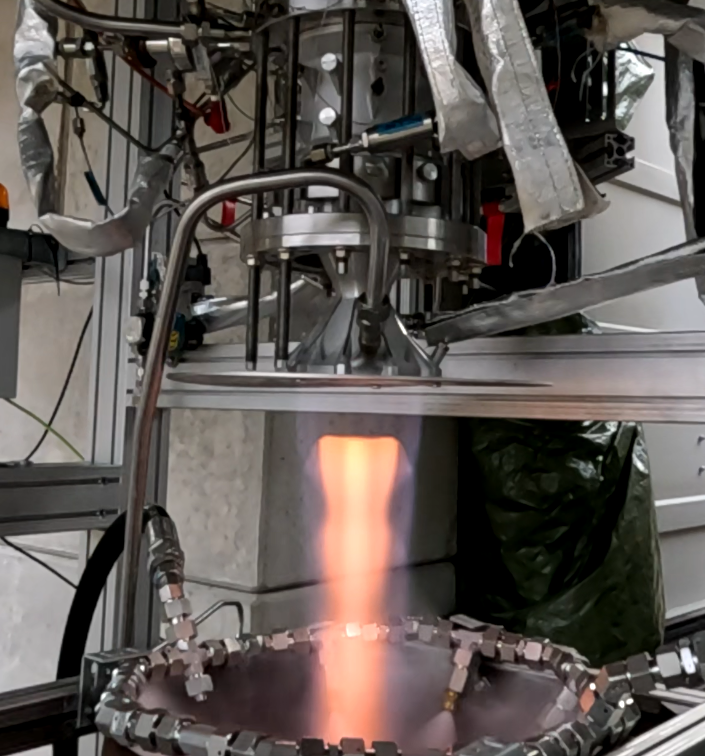
Between July and November 2025, the new “GRETA” rocket engine successfully completed its first hot-fire test campaign on the new mobile test bench at ArianeGroup’s site in Trauen, Germany. Following the promising initial results, ArianeGroup and ESA are now preparing the next stages in the development process. The objective is to test combustion chamber ignition and performance using new, greener propellants – specifically hydrogen peroxide and ethanol.
“GRETA” is part of the Storable Propellant Engines (SPE) family that are suitable, for example, for use in launcher kick-stages, upper stages of mini-launchers and lunar modules. Derived from SPE technology, these re-ignitable bi-propellant engines are particularly well suited to long duration missions in space. The “GRETA” variant is fuelled by hydrogen peroxide and ethanol, which are significantly more eco-friendly to produce and less hazardous to handle than the hypergolic propellants used in the baseline SPE engine.
However, these new propellants exhibit behaviour that differs significantly from that of previous formulations. The campaign conducted in Trauen was specifically intended to assess these properties on a test bench specially designed and built by ArianeGroup for ESA.
The primary objective of the test campaign was to gain a full understanding of the engine’s overall behaviour and to collect data on its combustion rate and cooling capacity. The results will support the development of dedicated analysis tools for future designs and provide practical feedback to optimise both the architecture and the manufacturing process.
This unique experimental prototype delivered several noteworthy results on the test bench. Thanks to the testing team’s ingenuity and ability to adapt in real time, the campaign was a clear success, with no fewer than 45 ignition sequences.
Although analysis of the results is still ongoing, the development team is already preparing the next phase of the project. Its continuation has now been officially confirmed in a contract signed by ArianeGroup and ESA within the framework of the Future Launchers Preparatory Programme (FLPP).
Drawing on the results of this campaign, ArianeGroup plans to test a complete engine demonstrator in 2027. In addition to the architecture structured around the combustion chamber produced by ArianeGroup, the demonstrator will include electric pumps, space-qualified valves and an advanced ignition system supplied ArianeGroup’s industrial partners.
SPE hot-fire test